Search This Blog

Friday, January 29, 2016

Ride or Die?

An Analysis of Gang Lifestyle through the Scope of Modern Film

By Austin Murphy


https://i.ytimg.com/vi/ls2w5UPs6eY/maxresdefault.jpg

          Regardless of your preferred taste in music or persuasion on the hip-hop/rap subculture, there is no denying that Tupac Shakur was a musical genius, a lyrical savant whose talent was such that the world chose to bring him back to life as a hologram like some bleeping Jedi out of Star Wars.
          In his 1997 single “Hail Mary,” released cryptically five months after his death on September 13, 1996, Tupac raps about zoning out the negativity and violence surrounding him, a result of his enduring experiences with crime, drugs, and gangs. The chorus presents two options to the listener, echoing what we can assume to be his internal struggle:
          
          “Do you wanna ride or die?”
           
          As has famously been documented and debated, Tupac both rode and died. Shot fatally while riding in Marion “Suge” Knight’s black BMW sedan in Las Vegas on September 7, 1996, Shakur died six days later at the University Medical Center of Southern Nevada. Though only 25 years of age at the time of his death, he is celebrated and revered as a pioneer of hip-hop.
          In the past two months I have watched two movies that, despite being released nearly a decade apart, both comment on the impact and influence of the gangster lifestyle to which Shakur so famously fell victim: Nick Cassavetes’ 2006 film “Alpha Dog”--which is based on a true story--and F. Gary Gray’s biographical 2015 film “Straight Outta Compton.” The latter of the two focuses, of course, on the formation and eventual dissolution of the hip-hop group N.W.A.

http://media2.fdncms.com/chicago/imager/u/original/18699438/straight_outta_compton.jpg

          Chronologically, N.W.A. came together in 1986 under the leadership of Eazy-E (Eric Wright) and was comprised initially of Ice Cube (O’Shea Jackson, Sr.), Arabian Prince (Kim Nazel), and Dr. Dre (Andre Young). Their meteoric rise helped proliferate the sub-genre of “gangster rap,” also known as “reality rap.” The biographical film covers the group’s success and strife as they dealt with racism, violence, drugs, crime, and internal disputes, eventually concluding with Wright’s death in 1995 after a battle with AIDS.
          As a biographical film, “Straight Outta Compton” deals primarily with the truth of these rappers' stories, although it is well-understood that directors have to take artistic liberty to shrink people’s lives down to two-and-a-half hours. Certain scenes are often imagined entirely and fictitious in nature, although for the most part the films remain historically accurate.
          The opening scene shows Wright escaping from a drug deal gone bad and potential incarceration. This part of the movie is true in a sense, as Eazy-E had earned as much as $250,000 selling drugs in the Compton area before the creation of N.W.A. Though diminutive in height, Wright was considered a “thug” in real life, earning protection and privilege in a city torn by gang violence.
Whether or not Eazy-E ever had first-hand experience dealing with guns cannot be proven, but growing up in Compton made it much more likely. Two specific instances where guns are seen in the film include the opening scene, when Wright is threatened with a gun by his “customer,” and a later hotel scene, when N.W.A. collectively scares off a group of would-be gangsters. Furthermore, the film lends credibility to the group’s experiences with gang violence, as Young’s brother Tyree was actually murdered in 1990 while N.W.A. was on tour, as referenced in the movie.
Technically speaking, N.W.A. came together nearly a decade before Tupac’s murder in 1996, but the deceased rapper is considered to be a contemporary of the group. “Straight Outta Compton” also portrays their association with Suge Knight through Death Row Records, establishing a parallel with Shakur’s actual life. What’s more, the film includes a scene showing Tupac recording the pre-discussed “Hail Mary” and his collaboration with Young on “California Love.” These two beloved songs remain hallmarks of Shakur’s celebrated discography.
Thus far it is prudent to note that “Straight Outta Compton” deals with real-life events, and the people and issues explored in the film are primarily true and accurate. This is an important distinction to make, as “Alpha Dog” provides a decidedly different perspective on the “gang” subculture of southern California.

http://www.trapclassics.com/wp-content/uploads/2014/07/Alpha-Dog.jpg

“Alpha Dog” deals primarily with the real-life kidnapping and murder of Benjamin Markowitz and related events in 2000, with the largest share of the blame falling on Jesse James Hollywood--known in the film as “Johnny Truelove.” Several of Hollywood’s associates are portrayed in the film as well, including Jesse Rugge, Natasha Adams-Young, and the actual murderer Ryan Hoyt.
In the movie, “Truelove” is presented as a young, “kingpin” drug dealer of his immediate circle of friends. Despite his role as the leader, or “Alpha Dog,” of his circle, his actions in the film show that he could not be less deserving of the title. Currently serving a life sentence for Markowitz’s murder, Hollywood even had the gall to sign his mail as “Alpha Dog” after the release of the film, despite the fact that he didn’t even have the male reproductive organs to commit the murder himself and had to convince Hoyt to do so.
The film in large part portrays “Truelove” and his friends as upper middle-class white kids living in Claremont, CA. They spend their days listening to hip-hop, selling and abusing illegal drugs, and taking advantage of their parents’ negligence and lack of supervision. While some part of the blame has to fall on the shoulders of the well-off, absentee parental figures, it doesn’t take a genius to know that kidnapping and murder are both illegal and wrong.
The roles of parents in the two films is an issue to be compared. In “Straight Outta Compton,” both Young’s and Jackson’s parents are portrayed as being caring, concerned, and present--an effective counter to the stereotype that African-American fathers are typically uninvolved in their children’s lives. While the film glosses over Young’s actual history of violence against women, it paints him as a responsible young father and older brother, working to create a better life for him and his family.
Contrastingly, the parents in “Alpha Dog” are shown to be irresponsible and unconcerned, allowing their children the freedom to do whatever they please--and the parents’ affluence and financial stability make it all that much easier to do so. Several scenes within the movie lend credibility to this notion, beginning first and foremost with “Truelove’s” father.
In the film, “Sonny Truelove” is shown to be protective of his son, though only in the sense that he doesn’t want him held accountable for his crimes. It is implicitly understood that he provided his son with marijuana to sell, reflected in real-life by the fact that Jack Hollywood spent time in prison for a marijuana charge. Despite urging his son to come clean late in the film, his “parental advice” comes far too late and falls on deaf ears.
As the film progresses, we see Rugge’s father portrayed as an irresponsibly alcoholic marijuana farmer, Adams-Young’s mother is shown to be more interested in sex than the well-being of her daughter, and Markowitz’s father is depicted as weak and easily manipulated--as his elder son, “Jake,” is a neo-Nazi speed freak whose debt to “Truelove” is the entire impetus behind the kidnapping and murder.
Ironically, given that the movie’s title parodies the phrase “Alpha Male,” the only characters who display any sense of morality or responsibility are females. The first is Adams-Young, “Susan,” (for responding hysterically to the kidnapping and trying to tell her mother--although her pleas are repeatedly ignored, especially when Rugge’s counterpart, “Frankie,” makes her repeat the phrase “I, Susan, am a whiny bitch, and you, Frankie, have it under control”) and the second is Markowitz’s mother (for condemning “Jake’s” actions and habits and being the only parent in the movie that you can tell loves or cares for her child).
The most contrasting facet of the two movies is that none of the spoiled youth in “Alpha Dog” is an artist, nor do they pursue anything that resembles a respectable living. All the while, “Truelove” continually shirks the responsibility of being the “Alpha Dog.” Compare this with the fact that in “Straight Outta Compton,” the leader of N.W.A., Eazy-E, doesn’t flinch in the opening scene when threatened with a gun. “Alpha Dog” depicts a lack of any such courage on “Truelove’s” behalf. He repeatedly totes a handgun but never once shoots another person, and the only violence he portrays is a half-assed, cowardly attempt to strangle a “friend” from behind.
The characters in “Alpha Dog” try to give off the impression that they live a “gangster,” “hardcore” lifestyle by abusing drugs, partying, and cursing, but if you think any of these kids can light a candle to someone like Eazy-E or Marshall Mathers and his life in Michigan--as depicted in “8 Mile”--you and I aren’t watching the same movie and you need a refresher on Eminem’s upbringing.

https://consequenceofsound.files.wordpress.com/2014/07/eminem-8-mile.jpg?w=1200

In the words of Mathers, “All you other Slim Shadys are just imitating.”

The film actually parodies itself during one scene, when Hoyt’s character criticizes a hip-hop music video:

“The only thing they shoot is music videos.”

At this point during the movie, I could only shake my head in disbelief at the gall of these real-life cowards. What the hell were you shooting? Innocent children? Because the only person killed in the entire movie or in real-life was a fifteen-year-old boy whose drug-addict brother owed money to a coward.
Ultimately, the movie came down to personal responsibility and bullying at the expense of the eventual murderer, Hoyt. But after all, isn’t “gangster rap” supposed to be about having thick skin and not letting anyone disrespect you or your “homies”? Eazy-E and Tupac paid the ultimate price for their gang involvement, especially because they saw the errors of their ways far too late. Clearly Hollywood and his crew missed that historical lesson.
Although I know nothing about the Compton lifestyle depicted in “Straight Outta Compton,” the film “Alpha Dog” reminds me very much of two kids I grew up with in Fresno--both of whose names will remain anonymous for obvious reasons. One was an elite athlete who could have competed at the highest collegiate level if he had his head on his straight. He was kicked off the team multiple times, and his predilection for hip-hop music, marijuana, and irresponsible friends ultimately hampered any chance of fulfilling his tremendous potential.
The other young man was a mediocre athlete, but he, too, continually spent time with the wrong crowds, tried to act “gangster,” and nearly destroyed his life by experimenting with drugs at a young age. I distinctly remember one practice when he arrived late and started crying after the coach told him he was going to end up in jail. I am no longer in contact with either of these individuals, so I cannot speak to their current affairs or possible criminal records. What I am certain of, however, is that neither has fulfilled the potential that so many people saw in them as young men.
What saddens me even more is the idea that simply spending time with misguided individuals can cost innocent people dearly, like in both films. Another excellent athlete I went to school with earned a scholarship to a Division-I university and had a relatively successful career while there. Eventually, however, he returned home to finish school and reconnected with old friends. This young man nearly lost his life after being literally “shanked” by an unsavory character while out on the town one night. Fortunately, he has recovered and still excels at his sport, and I am sure he regrets his chosen company on that fateful evening.
In summation, both movies are excellent and do a great job portraying real-life events. I cannot criticize the role of “gangster rap” in its essence, as I respect all art that is honest and uncensored. And I won’t pull an Eric Stratton and frame this as a condemnation of the United States of America, but there are people to be held responsible. The culprit here is the music industry and its commercialization of “gangster rap,” especially for its effect on an impressionable generation of middle class youth. The industry has made a fortune over the decades from marketing its products to unwitting consumers, especially teenagers and disaffected youth searching for an identity through music.
And so that brings me back to Tupac Shakur, his farewell single, and his assertion that there is a deficiency of well-adjusted individuals, or at least that there was a deficiency as he saw it back in the ‘90s:

“Fuck the world if they can’t adjust. It’s just as well, Hail Mary.”  

© Austin T. Murphy 2016 

Saturday, January 23, 2016

A Very Belated Christmas Miracle and God Bless America


Why Snow Miser Is Objectively Better Than Heat Miser

By Jason Brown

      When I first sat down to write this article, I didn’t really know how to start. But, here at UCSB, the first week back is called “syllabus week” (because we’re a glorious mix of clever and lazy, and because “syllabus” sounds much less intimidating than “Go drop $200+ on your textbooks”), and during our smaller, primarily-discussion-based classes, necessary (read: painful) introductions are made. Topics of decidedly-forced pseudo-conversation include name, major, city of birth, and (if the professor or teaching assistant is feeling especially adventurous) something interesting about one’s self. As it turns out, I’m Jewish, and unapologetically obsessed with Christmas (apparently not as much as some people,though). Movies, music, lights, trees: I love all of it. Unfortunately, it’s been almost a month since the most wonderful time of the year; fortunately (for you all), I have no self-control, and relapsed a few days ago. Specifically, I watched The Year Without a Santa Claus, which, upon a critical rewatch, might be one of the greatest children’s movies of all time. The thing that struck me most, however, was the discrepancy between two of the film’s most famous characters: The Miser Brothers. 

Some of you may already see where this is going.
      The Miser Brothers are the offspring of the omnipotent Mother Nature, and, as such, each of them controls a portion of the weather (if you haven’t figured out who holds domain over what by this point, there simply isn’t much I can do for you). They gained fame after their respective song and dance spots during the 1974 TV movie. The song is a rare mix of quality and catchiness that infallibly results in involuntary movement that at least somewhat resembles dance on my part any time I hear the Misers’ minions describing their masters. What I had never noticed as a child, however, is—though their songs are wildly similar (Heat Miser’s is but a slowed version of Snow Miser’s with tailored lyrics)—the brothers themselves could not be more different. 

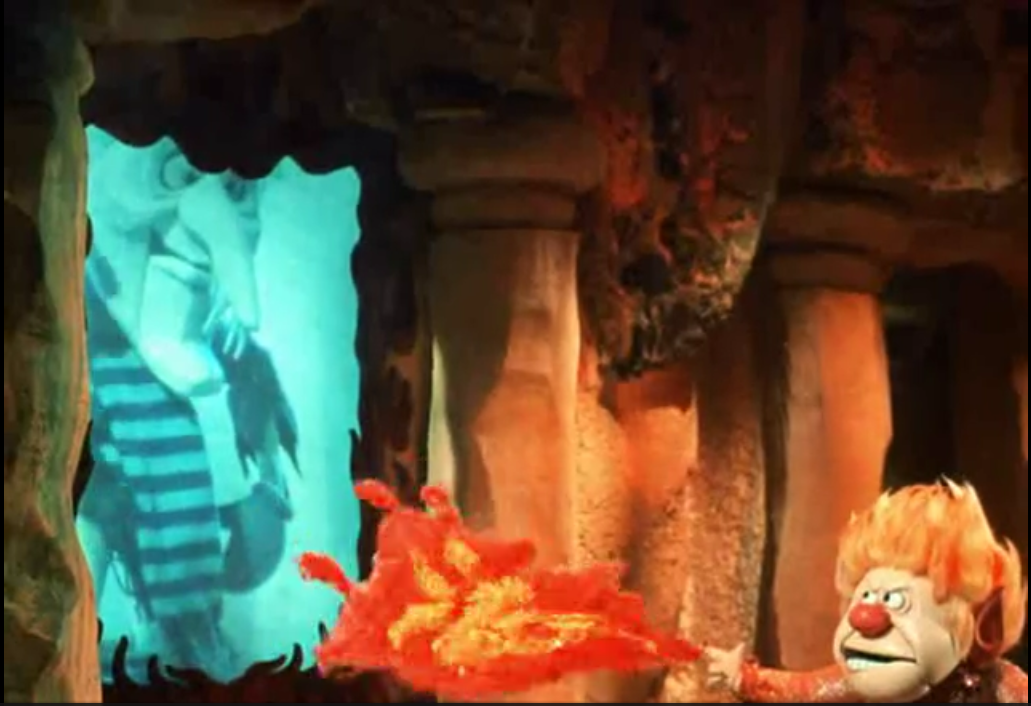
      From the outset of the movie, the audience is warned about Heat Miser. After Mrs. Claus sends Jingle and Jangle (two of Santa’s elves) out on a mission to save Christmas, her beloved husband, upon reminding her of the fact that the path chosen for the pair by Mrs. C lands them right between the two brothers, remarks, “If Snow Miser doesn’t freeze ‘em just for the fun of it, his devil of a brother will put the heat on ‘em for sure.” Now, keeping in mind that this is, at its core, a family Christmas movie, one might be inclined to dismiss Santa Claus’s worries as overblown, and his labelling of Heat Miser as a devil as innocent hyperbole; the reality of this movie is surprisingly darker. Upon Jingle and Jangle’s first encounter with Heat Miser, Heat Miser bemoans the fact that they are elves, and attempts to kill them. 

No, seriously. Those are literally angry murder rays.
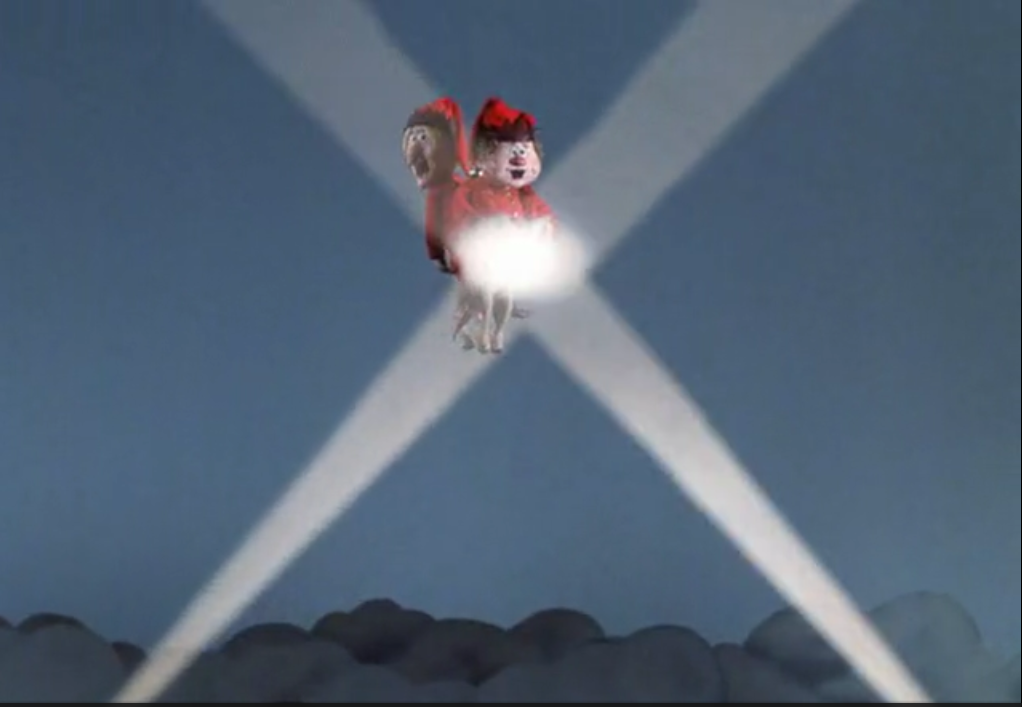
When Vixen, the baby reindeer that gets fried and drops the duo, consequently pulls off the greatest flying maneuver the North Pole has ever seen, 


Heat Miser laments that “they got away.” In other words, he is visibly upset because the three most lovable characters of the movie thus far managed to survive his attempted murder.

      After, a beautiful scene about the inexorably linked natures of faith and love is juxtaposed with a scene in which the characters take advantage of the reigning government’s smug confidence in the fact that an event that has not occurred for an extended period of time will not occur, a la Charlie Geller and Jamie Shipley (if you have not yet seen The Big Short, do yourself a favor and buy a ticket. Not now, of course. Right now you’re too busy reading this. This is important). After shorting the weather, Jingle, Jangle, and the phenomenally-named Ignacious Thistlewood set about ensuring the favorable outcome of their wager. To this end, they—now under the calculated command of Mrs. Claus—elect to visit Snow Miser. In response to receiving this information, Jingle and Jangle have no palpable reaction.

      Upon their arrival, Jingle, Jangle, Mrs. Claus, and Iggy are treated to the aforementioned song and dance. During this dance, it is established that anything touched by Snow Miser will turn into snow.

Throughout the duration of his song, Snow Miser touches several hats, including Jangle’s, all of which he immediately returns. Whenever he himself is not singing (the melody is carried by his minions at certain points), he is laughing gleefully; Snow Miser is, by all accounts, having the time of his life. The first thing he does after finishing his routine is to ask Mrs. Claus about her “hubby.” When Iggy takes admirable, though perhaps misplaced offense to Snow Miser’s playful jab at Santa Claus, claiming he is the nicest person in the world, Snow Miser responds, in a gentle tone: “Well of course he is, sonny; I love him a lot . . . Well of course I do!” He then proceeds to ask Mrs. Claus what she needs, and, after she tells him she needs snow in a town, he immediately sets about doing it without so much as a response. It is only until he realizes the town resides in the domain of his brother that he hesitates, informing the gang that previous attempts at “a little refreshing snow” in that area have consistently resulted in rain. Mrs. Claus resolves to speak with Heat Miser, but not before Snow Miser politely invites both her and Santa Claus back. When Jingle confirms with Mrs. Claus to whom they are about to pay a visit, he remarks fearfully “I was afraid you’d say that.” Heat Miser is hated by the inspiration for this guy, and, as it turns out, for utilizing essentially the same song, Heat Miser’s performance is the polar opposite of his brother’s. Heat Miser is scowling throughout the entire song, touch-melting at least three things (including a very complex piece of weather equipment) and not restoring a single one of them.


Fuck this spot in particular.

That satellite-looking thing is one of the heat rays that was used on Vixen, Jingle, and Jangle, and it is likely a piece of machinery that required hours of work; Heat Miser obliterates it without a second thought in front of the people who worked tirelessly on it. Look at that employee’s face. That is the face of a man who is watching his boss destroy his work, and can do absolutely nothing about it. After systematically demoralizing his workforce, Heat Miser elects to vehemently insult Santa Claus and everything for which he stands; this is all before Mrs. Claus has said a word. As it turns out, Heat Miser blames his brother, Santa Claus and pretty much everyone else for his perceived slights. To wit, when Mrs. Claus asks if he might allow one day of snow in a town that hasn’t had it in 100 years, his gut reaction is a resounding “NEVER!” His ensuing response to this overwhelmingly reasonable request is that he receive control over The North Pole. To this point in the movie, two key things have been established: first, that Heat Miser, if given the opportunity, would have every day at 100°, and second, that reindeer cannot survive in warm weather. During Jingle and Jangle’s trip to Southtown, Vixen gets disturbingly sick, and needs to be rescued by Santa Claus. Turning over control of the North Pole to someone with an agenda against Santa Claus is tantamount to the calculated extermination of a species. When Mrs. Claus proposes the idea to Snow Miser, he reacts (predictably) poorly, shocked that his brother would even make such a request. When Heat Miser attempts to flip the blame for the unresolved nature of Mrs. Claus’s journey on his brother’s uncooperativeness, Snow Miser responds indignantly: “Cooperate?! Surrender the North Pole you call cooperate???” Mrs. Claus eventually decides to go over the heads of the Miser Brothers, “right to the top,” and all is well when the unpredictable Mother Nature sets her boys straight. 

      Snow Miser is clearly the better human being in this scenario, and it’s not even close. In spite of this fact, the two of them are portrayed as equals. Heat Miser is an angry, yellow-haired whirlwind of unpredictability without a filter, yet, because of his power and unapologetic nature, he has an all-but blind following.


At least Heat Miser doesn’t want to repeatedly fuck his daughter.

Snow Miser, on the other hand, is cool, calm, collected, and incredibly polite. His sense of humor is admittedly a bit twisted, but he constantly reassures his audience that his punny jokes are just that: innocent and harmless, if not slightly warped. From what the audience can tell, he is an animal lover, and uses his power for practical jokes that are immediately rectified, not violence. His outlook on life is one of benevolence and responsible carelessness. He does not blame the actions of others on a less powerful group of individuals, as does his brother, and it is no wonder that he is by far the happier of the pair. Heat Miser complains that their mother prefers his brother (though there is no evidence to support this claim; she is unequivocally fair in her dealings with them) and cites it as a source of his pain, instead of looking inward, and reflecting on why people in general might favor his brother. Heat Miser has stubbornly shut out the world in spite of the fact that everything has essentially been given to him from his birth (yes, the parallels are starting to concern me as well), and derives his only pleasure through the suffering of others.


You’re fired!
Be like Snow Miser, everyone. Love, laugh, believe in miracles, have sublime experiences, take pleasure in the little things, and please, for the love of God/Science/Undetermined/Your personal belief system here, don’t vote for Donald Trump.

© Jason Brown 2016 

Friday, January 8, 2016

Courage and Love in the Arizona Desert

“Things Are Things”

By Austin Murphy

Chris Frailey

          I have asserted time and time again that I am not omniscient, never will be, and I don’t strive to conquer all knowledge. At some point, however, it is fair to say that I DO know some things. I know how to cook pasta. I know that the square root of four is two. And I know how to identify an asshole when I see one.
          In addition, I also know that the world we live in is so intricately nuanced that there is naught but to accept the wondrous disbelief that accompanies miraculous moments.
          And to be clear, it is crucial to acknowledge that miracles happen infrequently and aren’t easy to recognize, but an open-minded person will more often than not realize when a greater power has intervened on their behalf.
          Just before New Years, I traveled with 16 other friends to Chandler, Arizona. There we discovered more than just self-serving debauchery, hedonism, and lawlessness. We explored more than just the inner-workings of ourselves, and we found more than just a higher purpose.
          We found each other. We fortified friendships. We learned that the Arizona desert is a cold, unforgiving place, and we needed our mutual understanding and care to survive the winter evenings.
          Once upon a time, I had a girlfriend whom I loved very much. She had a warm, caring heart, but one thing that has always bothered me is her insistence that I “lacked” valuable possessions. And while, at the time, I would have agreed that I didn’t have much in the way of “toys,” I would argue that I am wealthier now than in previous years--regardless of my belongings.
          The most invaluable possessions that I have accumulated in recent years are friendships. Ever since I was young, it has been a personal struggle of mine to forge lasting bonds with people, especially because of a constant turnover in my youth. When I was eleven, two of my best friends moved away. In eighth grade my best friend left for the Philippines, and it took until midway through my sophomore year of high school before I had a clear-cut friend group again--although this was more because all of us were rather lost and insecure in our ways. To make matters worse, this all came during a period of my life when I struggled socially and was dangerously introverted.
College changed me, but at the same time, it wasn’t in the way I expected or planned. I immediately joined a fraternity, confident that I had finally found the “brothers” that I would keep for life. But despite the house’s assertion that my pledge class would provide the “closest friends in this lifetime,” I’ve found that it gave me the exact opposite. The majority of my pledge class is without a doubt the cliquiest, most disloyal group of people I’ve ever encountered.
But within that snake pit of 26 young idiots, I managed to find one brother that is still arguably my closest friend. And despite the turmoil I withstood over the next four years, I have found a few others, dispersed amongst the other pledge classes, that I know will be my best friends for life.
And so I return to our time in Arizona. The fraternity gave me four years of experiences and memories that did little to strengthen my bonds and much more to elucidate who I can count as a true friend. I spent 72 hours in the desert and already know that I can trust my 16 compañeros with anything and would do anything for each of them.
And so it is proven again that the world is a funny place. Experiences mean infinitely more than possessions, although it is hard to tell which experiences will prove to be the most important.
Obviously, I am a far different person now than when I met my fraternity “brothers,” but I can’t help but fall back on the fact that the friends I’ve made over the past two years, in several different cities, are more open-minded, accepting people than I’ve ever known. It almost feels like a sense of magnetism; everywhere we go and enjoy ourselves, I feel like we attract like-minded, happy people who want to share in our enjoyment.
With that, I’ll circle back again to the idea of miracles. And as a self-admitted non-omniscient being, I can say without a doubt that my experience in Arizona was a miracle, and my decision to move back to Santa Barbara was the absolute right decision for my life. I am done questioning my gut instinct, even though it still trembles in fear at times.
Because I know that the trembling is actually vibrating, and the fear is excitement. There is too much natural good in this world to let yourself be paralyzed by fear (and by God I sound an awful lot like Patrick Swayze or the crazy, old bat Beth Grant plays in “Donnie Darko.”)
Fear is a necessary reaction we have developed over the course of human history. But in all honesty, the kinds of things we dread or bemoan in our daily, well-adjusted lives just aren’t worth the effort. No one is going to cause you physical pain if you are rejected by that cute, blonde barista at Starbucks if you ask her out. Your life won’t be adversely impacted if your dream job rejects you during a job hunt.
            Now if you’re reading this and you work in a dangerous field that deals with pain or death on the daily, then I apologize profusely and will permit you to continue to dwell in fear. But you should understand that there are alternatives to this lifestyle, and you deserve to find the best in life. Even suppressed, unsatisfied people in the 18th century understood that it is our natural right to pursue that which makes us happy.
            None of us is omniscient nor perfect, but we are all made of the same basic elements, and we all are capable of recognizing that supreme joy and an honest smile are two of the most beautiful things to behold on this sacred Earth.

© Austin T. Murphy 2016 

Thursday, December 17, 2015

Fun Time With Pay Mon ("Welcome to the Jungle")

Fun Time With Pay Mon ("Welcome to the Jungle")

By Jason Brown

http://ethicsalarms.com/2014/04/05/the-ethics-alarms-list-of-debate-cheats-and-fallacies/

A few weeks back, my partner wrote a wonderful piece in which he referenced, among other, entertaining topics, the highly controversial response to Jason Garshfield’s piece entitled “The Demonization of Greek Life.” Needless to say, he took great issue with the article, and the manner in which it (in no way) refuted and addressed Garshfield’s main argument. I must confess that, upon reception of Austin’s article for editing, I had read neither the original article nor the response, though I was generally aware of their existence. After having read both (extensively), I can assure you that my colleague merely scratched the surface.

One of my favorite websites (that has since—essentially—discontinued), Kissing Suzy Kolbert, did a weekly takedown of Peter King’s Monday Morning QB column. For those of you who don’t know (and you should consider yourselves lucky), Peter King is the head writer over at Sports Illustrated. He is an absolutely despicable human being for reasons that I won’t get into (we’ll never get to the actual article if I do), and, every week, pens a 10,000+ (with a heavy emphasis on the +) word column recapping the prior week’s football events. It sounds innocent and simple enough, but… it just… it isn’t, okay? Please, please trust me on this one. Anyway, each Monday, one of the writers, Christmas Ape, would delve into the depths of King’s self-indulgent gibberish and systematically, humorously obliterate his column, phrase by phrase. This is called a takedown. After taking my first crack at one (Pay Mon’s response piece, which, although horrific, pales in comparison to King’s ramblings), I am firmly of the belief that Christmas Ape is nothing less than an American hero.

This one’s for you, you hunk of man, you.

*The emboldened text represents passages from Pay Mon’s piece, while the normal text is my own*

Any student of color reading that statement must have been upset that, once again, the struggle of non-white students had been thrown under the bus so that white men, who pay thousands of dollars a year in order to live a Greek lifestyle, could claim that they experience institutional oppression.

We’re off to a great start here, as—from the second sentence of her ‘response’—Pay Mon demonstrates a fundamental miscomprehension of Garshfield’s argument. His main point is that the mistreatment of Greek institutions at UCSB is cause for concern of other groups on campus, such as clubs and minorities. The lack of due process evident in these cases is something that should worry all organizations, not just ‘frat boys,’ argues Garshfield. It is perfectly acceptable to disagree with, and argue against, Garshfield’s point; that is part of starting a dialogue. That however, is not what happens throughout the course of Pay Mon’s article, a fact that is established early and often.

It’s no surprise that 48 percent of Presidents, 42 percent of Senators, 30 percent of Congress members and 40 percent of Supreme Court Justices have been a part of Greek life — this is hardly a group of people that faces “institutional persecution and condemnation.”

The fact that a group of people did not, at one point, face oppression is in no way evidence that that group does not currently suffer from it; slavery no longer exists as it did during colonial America, but that certainly does not mean that black people are not oppressed today strictly because of the color of their skin, just as having a black President does not indicate the eradication of racism in America.

For those of you who are wondering, I didn’t leave out a hyperlink in the quoted text; Pay Mon cited no data for statistics. If that is the sort of thing that bothers you beyond reason, I suggest you stop reading here; it will become a theme of this piece.

If Greek life has any negative stigma attached to it, it is because of the very real occurrence of rape that happens at fraternities; this is an issue that our campus has been painfully slow in dealing with. When a woman was attacked by a group of Asian men on the street in 2013, we spent weeks posting flyers and borderline racist police caricatures in an attempt to identify the perpetrators.

The Asian men referenced herein were in no way affiliated with Greek life. Rape on college campuses, and in our country as a whole, is a massive problem, and one that desperately needs to be addressed in an effective, productive manner, but this case had nothing to do with Greek life. There certainly have been cases of rape in fraternities (although, upon closer examination of that list, it becomes clear that many of the rapes happen either outside the involved organizations, or are caused by unaffiliated persons), but that in no way means that it is permissible to attribute all cases of rape in the surrounding area to fraternities; that’s not how it works.

However, we know that rape happens on a weekly basis in the fraternities of Isla Vista

“We” do? According to what data, exactly?

yet rarely are the perpetrators’ faces plastered around the school

This may have something to do with the fact that rapes don’t occur in UCSB fraternities on a weekly basis (we didn’t even make Gawker’s list for 2014; in fact, rape was not the reason that houses such as Beta Theta Pi were thrown off campus—two members drank too much and were brought to the hospital by their fraternity brothers—but that’s a story for another time).

This dynamic is apparent culturally — think of the popular catcalling video made by a white woman last year that became viral. The men featured in that video were overwhelmingly men of color,

Okay.

despite the fact that all men are responsible for patriarchal violence against women.

But not catcalling, apparently.

This dynamic again is reproduced on our campus, where white men (and now up to five percent non-white men #liberalprogress) who can afford membership in fraternities are promised the experience of “fraternity life,” which includes fraternity parties and sexual exploits at those parties.

I don’t think Pay Mon knows what Greek life entails…

Also, the article was noticeably rife (even for a Daily Nexus piece) with errors such as the ones in this paragraph.

These cases are also kept under wraps by the social pressure exerted on victims by the Greek system to keep quiet or risk becoming a social pariah who caused the closure of a fraternity.

Nowhere in the article does Pay “Digi” Mon offer a source for this claim, or others like it. Also, there is plenty of hatred towards Greek life at UCSB; people aren’t exactly losing sleep over the fact that four houses were discontinued this past year. The idea that one would become a “social pariah” is not only an unfounded one, but one that is easily disproven by talking to members of the community (or just glancing at the school’s Yik Yak Feed during any finals’ week: #AlphaCheat #neverforget).

I’m not saying that all members of fraternities are rapists, and frankly, if that’s what you drew from my previous paragraph, you’re missing the point.

Kind of like you completely missed the point of Jason Garshfield’s article?

I’m saying that the issue of institutionally protected rape at fraternities is a very serious and heavily racialized issue.

But… You just claimed that non-white males are involved in these sexual crimes as well. Isn’t that something you should address by more than simply tossing out “#liberalprogress”? Are Greek institutions brainwashing minorities on top of their weekly rapes? That’s an awfully busy schedule. These guys do need to find time for beer die, you know.

Look, race and racism is obviously a very real problem in America—and in certain iterations of Greek life—and there are a myriad of ways to breach discussion of that issue in a productive manner; this is not one of them. The author has made no real effort here to effect any sort of dialogue, instead electing to lazily toss in race in a way that contradicts herself, and accomplishes nothing.

Just this year, Andy Sanchez, a student at UCSB, bled to death because of the inaction of Santa Barbara sheriff and fire officials who refused to treat him in a timely manner because of his race. This led to Sanchez’s death, once again highlighting the terror inflicted by police on students of color.

This is the toughest part of the article, and it was at this point that I had to stop reading and compose myself. As awful as the rest of the article is, it’s relatively harmless until Pay Mon brings in the death of another student to support her argument. Andy Sanchez’s death was a tragedy, and my heart goes out to his family and all those affected in any way. However, Pay Mon has wildly misrepresented the circumstances of Sanchez’s death for her own personal agenda, and contextualizing this event in order to bring to light Pay Mon’s actions was and is a painful process. It brings me no pleasure to do this, and it infuriates me that the author brought this event into her article.

Here goes nothing.

Aside from not citing anything (which, to be fair, I should be used to at this point in the article), Pay Mon conveniently leaves out pertinent details of the case (like, for instance, how Sanchez was injured).

I cannot stress enough how much this upsets me.

Andy Sanchez, under the influence of ketamine, 25I-NBOMe, and weed, ran to his apartment at 4:40 in the morning and punched a glass window, shattering it. For anyone who doesn’t know (I certainly didn’t), 25I-NBOMe is a hallucinogen not unlike LSD, but deadly if taken in similar dosage; it caused the death of an Australian man in a fashion similar to Sanchez. After a friend came out in an attempt to help Sanchez, he tried to rape her. Police arrived on scene, followed later by paramedics, and Sanchez died in the hospital a few hours later.

An article popped up in (surprise) The Daily Nexus following the event claiming that Sanchez’s death was the result of negligence by the present officers and paramedics, and that their lack of urgency was due entirely to Sanchez’s race. Though the author of the Nexus article offered no proof of his wild accusations, the story quickly caught fire. Witnesses from that night came forward to testify to the AS Senate, claiming that the responders were moving too slowly, and that the only person to whom officers spoke was white. Officers responded thoroughly (and rather convincingly) to each claim made by the witnesses, but that is not always the most reliable source of information.

Paramedics are not supposed to rush around during a call; adrenaline can cause mistakes to be made, mistakes that can cost people their lives, and running in a stressful situation can trigger such reactions. They are not unlike surgeons in this respect; it behooves a surgeon to be calm, quiet, collected, and polite during emergency procedures, as having a member of one’s team crack due to a stressful combination of pressure and a surgeon’s harsh tone is incredibly counterproductive. So, what appear to be lackadaisical movements to a stressed onlooker is actually a conscious effort on the part of paramedics to give the victim the best chance to live. As for the officer’s purported racial exclusivity, the person to whom they spoke was Sanchez’s roommate, and, as such, they assumed—perhaps incorrectly—that he would be able to divulge the most relevant information.

Essentially, a student was on several controlled substances at once, sustained an injury that was self-inflicted, and tried to rape his friend. After adhering to protocol, responding officers and paramedics were blamed for his death due to claims of racism.

This research took me over two hours to conduct. I was as thorough and unbiased as I could possibly be, in an effort to determine the real story. It was difficult, time-consuming, and taxing… and it should have never had to happen. The burden of responsibility lies solely with Pay Mon in citing such a complicated, tragic story in an effort to prove her point. As authors, it is our job to objectively contextualize when using a tragedy such as Andy Sanchez’s in a heavily-opinionated article, not pervert a story for our own ends. Journalism requires much more integrity than exhibited by Pay Mon, and there are not adequate words to express my disgust with her actions.

Unfortunately, the article continues (yes, on top of everything else, Pay Mon’s reference to Sanchez’s death was a throwaway one).

Going to any party in Isla Vista guarantees the sight of many white people shouting the N-word and referring to each other with the N-word while side-eying any black people who enter the party.

There is no evidence to support this anecdotal claim.

No person aware of the brutal history and current reality of racial violence in America would dare use that sort of language unless they fundamentally did not see the humanity of black people.

Except for, you know, every modern rapper in existence, the vast majority of whom are black.

And then there’s this.

Isla Vista has no shortage of offensive costumes displaying racial stereotypes. White men dressed as “Arab Sheikhs,” completely ignoring the fact that the United States military has murdered hundreds of thousands of innocent Arabs through its indiscriminate bombing campaigns in Iraq and Afghanistan and has continued to use drone strikes in Yemen, Pakistan and other regions in the Middle East.

The first part of this is actually true: cultural appropriation is a genuine issue, especially around Halloween (though this is an issue that is hardly restricted to UCSB). The rest of the passage, however, is an incredibly basic oversimplification of an intensely complex issue; it is the job of the author to dive into this issue, providing sources and analysis to back up her point, but Pay Mon instead tosses out a statement to be presented as fact, and I sound like a broken record at this point.

White women dressed in sombreros and ponchos, completely glossing over the continued exploitation of migrant workers in the United States, demonization of and violence towards Mexican immigrants and large-scale economic exploitation of Mexico through the North American Free Trade Agreement, or NAFTA, which has led to a massive influx of immigrants.

This isn’t actually a sentence.

This purported “response” to Garshfield’s article has barely addressed the original piece in any constructive way to this point, and has instead turned into a rant about how awful white people are. This is neither productive nor relevant to Garshfield’s article.

I used Yik Yak for several weeks, posting under the username “KarlMarx420” to call out these instances of racism, and I witnessed the sheer magnitude of reactionary hatred present in white students using Yik Yak.

This is just a blatant lie. One does not have a username on Yik Yak; it is completely anonymous. The only way to refer to or identify another user is by an assortment of randomly-assigned colored icons that change from thread to thread. It is not overly difficult to point to racism on Yik Yak; there is no need to invent stories to prove that point.

At no point have I ever seen white students apply social pressure to other white students to . . . stop any of the other horrible things white people do on a regular basis.

Pay Mon finally says what she has been dancing around her entire article: she is literally saying white people are horrible human beings that consistently do awful things.

She goes on to discuss UCSB’s science program’s direct involvement with weapons manufacturing, a subject about which I am in no way qualified to talk (and neither is she, for that matter); she again fails to cite a single thing.

Without even touching on our campus’s continued support of Israel, a white supremacist colonialist settler state predicated on the death and destruction of indigenous Palestinians

*sigh*

The creation of Israel was handled extremely poorly, but this is an incredibly complicated, multi-faceted issue that is debated by historians to this day. This is another wild oversimplification without (and I swear I’m beginning to see a pattern here) sources. I’m starting to think Pay Mon enjoys opening up huge cans of worms just for fun.

The ignorance of the white student body has only fed this unsafe atmosphere, and the column posted by the Daily Nexus last week is indicative of this attitude. White people will go so far to ignore the real oppression faced by people of color that they will claim that members of a white privileged drinking club face institutional oppression before they admit that racism exists on campus.

This is the closest Pay Mon comes to addressing the article to which she is purportedly responding, and she again fails to grasp the central argument: that the treatment of Greek life on campus should be cause for concern for minorities, as they could end up being treated in an uncomfortably similar fashion.


That about covers it. If you want to subject yourself to the original article (and I highly recommend that you do not), it is linked in the opening paragraphs. I have no good way to close this post, and I really don’t think there is one. Feel free to reach out to me with any thoughts or concerns.

© Jason Brown 2016